Ranking first on Google no longer guarantees you will even be mentioned in the AI answer sitting directly above your link. In my experience auditing marketing content programs, this traffic-to-citation disconnect has become the single biggest blind spot for marketing leaders and practitioners. A brand holds a top-three organic position for a high-intent category term, assumes its search visibility is secure, and then watches a smaller competitor—or a third-party review thread—capture the actual citations inside Google AI Overviews, ChatGPT, and Perplexity.
When buyers use AI engines to build shortlists, a missing citation is not just a lost click. It is silent exclusion from the consideration set before a prospect ever reaches your site.
The mistake most teams make is treating “AI search” as one unified channel and applying a single, generic SEO checklist across all of it. In reality, Google’s AI Overviews (powered by Gemini), ChatGPT, and Perplexity retrieve, filter, and attribute information through fundamentally different mechanics. To earn citations consistently, you have to understand how those pipelines diverge—and stop publishing derivative SEO articles in favor of what I call citeable assets.
The Traffic-to-Citation Disconnect: Why Page-One Rankings Fall Short
Traditional search engines rank whole web pages against a single head query. AI answer engines do something very different: they decompose a user’s prompt into sub-questions, retrieve specific passages across multiple indexes, and synthesize an answer from the claims they can verify and extract cleanly.
Public industry research confirms just how wide the gap between traditional rankings and AI citations has become:
- Google AI Overviews no longer mirror page one: In a March 2026 study of 863,000 keyword SERPs and 4 million AI Overview URLs, Ahrefs found that only 38% of pages cited in AI Overviews also ranked in Google’s organic top 10—a sharp drop from the 76.1% overlap Ahrefs measured in July 2025. Roughly 36.7% of cited URLs did not rank in the top 100 at all.
- ChatGPT frequently bypasses top Google results: According to Semrush’s AI search study, pages cited by ChatGPT ranked in position 21 or lower on Google nearly 90% of the time.
- Cross-engine citation overlap is tiny: Analysis of citation patterns across ChatGPT, Perplexity, and Google AI Overviews shows roughly 9% citation overlap across the three platforms, meaning a page winning citations in one engine is routinely invisible in the other two.
When a competitor with weaker domain authority beats your top-ranking guide inside an AI answer, it is rarely a fluke. It happens because their content matched the specific retrieval filter of that engine while your page was built strictly to satisfy a classic keyword brief.
The Retrieval Divergence Framework: How Gemini, ChatGPT, and Perplexity Select Sources
To diagnose why a page earns citations in one engine and disappears in another, I evaluate AI visibility through The Retrieval Divergence Framework. Rather than optimizing for a single algorithm, you are auditioning for three distinct retrieval pipelines:
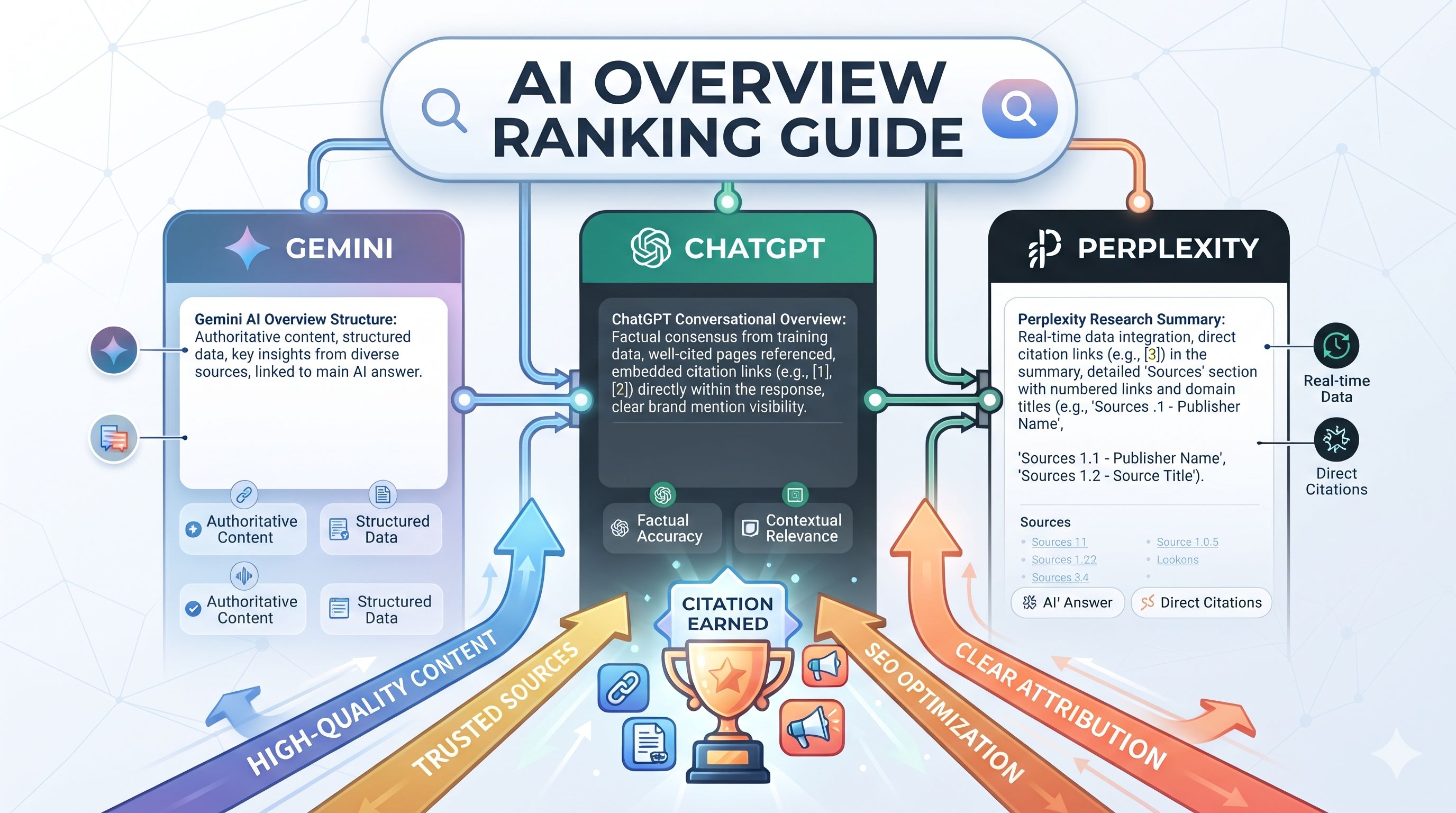
| Dimension | Google AI Overviews & Gemini | ChatGPT (Search & Synthesis) | Perplexity |
|---|---|---|---|
| Primary Retrieval Mechanism | Google index + query fan-out across related sub-intents | Real-time web search + training weights + encyclopedic/entity grounding | Live real-time search index with strict per-claim footnote attribution |
| Reliance on Google Top 10 | Moderate & declining (~38% top-10 overlap per Ahrefs, March 2026) | Low (nearly 90% of cited pages rank 21+ per Semrush, July 2025) | Moderate; recency and direct answer density routinely beat legacy rank |
| Dominant Source Bias | Multi-source consensus: brand sites, YouTube, and Reddit (21% of top-source share per Profound) | Authoritative reference bases: Wikipedia accounts for 47.9% of top-source share per Profound, plus clear domain pages | Community validation & fresh web sources: Reddit accounts for 46.7% of top-source share per Profound |
| What Wins the Citation | Deep subtopic coverage answering fan-out questions + multi-format proof | Top-loaded definitions, definitive claims, and high named-entity density | Recently updated pages, explicit statistics, and peer/community corroboration |
1. Google AI Overviews & Gemini: Query Fan-Out and Multi-Source Consensus
When a buyer asks a complex marketing question on Google, Gemini does not simply pull the top three blue links and summarize them. It uses query fan-out—splitting the original prompt into multiple underlying sub-queries covering definitions, pricing, comparisons, edge cases, and follow-up questions, then retrieving passages that answer each branch.
As Surfer’s breakdown of query fan-out highlights, pages that rank only for fan-out sub-queries get cited significantly more often than pages optimized narrowly for a single head keyword. Furthermore, Google’s synthesis layer looks for consensus across formats. In Ahrefs’ March 2026 data, 18% of AI Overview citations outside the top 100 came from YouTube, alongside strong representation from Reddit and established brand domains.
What this means for your content: If your pillar page covers a broad topic at surface level while leaving granular comparison, implementation, and pricing questions unanswered, Gemini will stitch its answer together from niche competitor pages and video walkthroughs that directly answer those fan-out branches.
2. ChatGPT: Entity Clarity and Top-Loaded Extraction
ChatGPT behaves less like a traditional SERP mirror and more like an extraction engine hunting for clean, self-contained statements it can attribute with low ambiguity.
In an analysis of 1.2 million ChatGPT responses, Growth Memo founder Kevin Indig identified a sharp “ski-ramp” citation pattern: 44.2% of all citations came from the first 30% of a page’s text, compared to 31.1% from the middle and 24.7% from the final third. Indig’s research also found that cited content averages 20.6% named-entity density (specific companies, products, people, metrics, frameworks, and dates), compared to roughly 5–8% on typical web pages, and that definitive framing outperforms hedged language (“might,” “could potentially”).
What this means for your content: Long, narrative introductions that bury the core definition or thesis 400 words down the page are nearly invisible to ChatGPT’s extraction window. When a smaller competitor puts a crisp, entity-rich definition and benchmark table in the opening 150 words, ChatGPT cites them—even if they sit on page three of Google.
3. Perplexity: Freshness, Granular Footnotes, and Community Proof
Perplexity operates with an explicit, claim-by-claim citation architecture. Every sentence in a Perplexity response is tied to a numbered footnote, which forces the engine to look for pages containing discrete, verifiable facts rather than broad editorial commentary.
Two signals weigh disproportionately in Perplexity’s source selection: recency and peer corroboration. In Profound’s analysis of 680 million AI citations, Reddit accounted for 46.7% of Perplexity’s top-source share—more than double its share in Google AI Overviews. Meanwhile, industry studies on AI crawler behavior consistently show strong recency bias across real-time answer engines, with stale pages decaying out of Perplexity’s citation pool far faster than in traditional organic rankings.
What this means for your content: An evergreen marketing guide published two years ago with undated claims will steadily lose Perplexity citations to a newer benchmark post or an active community discussion, regardless of how many backlinks the older guide holds.
Why Generic SEO Articles Get Skipped
Looking at these three retrieval pipelines together reveals why traditional top-of-funnel SEO content struggles in AI answers.
For years, content teams scaled traffic by writing comprehensive “What is X?” and “Complete Guide to Y” articles that synthesized consensus advice already available across the top 10 search results. From a language model’s perspective, if an article merely restates consensus knowledge already encoded in the model’s training weights, there is zero marginal value in citing that URL.
In the foundational Generative Engine Optimization (GEO) research paper presented at KDD 2024 by Aggarwal et al., researchers tested content modifications across 10,000 queries on generative engines and found that adding concrete statistics, credible quotations, and explicit source citations boosted visibility by up to 30% to 40%, whereas traditional keyword stuffing actually performed worse than making no changes at all.
In short: models cite sources to ground specific claims—numbers, definitions, comparisons, and primary observations—not to credit someone for summarizing common knowledge.
How to Turn Generic Posts into Citeable Assets
If you want your brand cited across Gemini, ChatGPT, and Perplexity, shift your editorial standard from publishing keyword-targeted articles to building citeable assets. Based on what consistently earns attribution in practice, every priority page should be engineered around four structural pillars:
1. Front-Load Definitive Answers in the First 150 Words
Treat the opening of every page—and the first two sentences under every H2—as a standalone extractable block.
- State the direct answer, definition, or core thesis immediately in plain, declarative language.
- Eliminate throat-clearing introductions and hedging qualifiers.
- Ensure that if an engine extracts only your opening paragraph or a single H2 block, the claim remains complete and self-contained without needing surrounding context.
2. Anchor Sections in Proprietary Data and Primary Observations
Give answer engines a factual reason to cite your domain instead of a generic aggregator.
- Publish original benchmarks, anonymized telemetry, audit findings, pricing analyses, or structured customer patterns that exist nowhere else on the web.
- Pair every quantitative claim with clear methodology context (sample size, timeframe, and scope), which increases trust for both Perplexity’s footnote verification and Gemini’s consensus checks.
- Include named frameworks and concrete entity relationships (specific tools, standards, roles, and workflows) rather than vague industry abstractions.
3. Map and Answer Query Fan-Out Sub-Intents on One Page
Do not stop at the primary keyword. Audit the adjacent questions a buyer asks immediately after the initial prompt:
- Comparison & trade-off tables: Structured HTML tables comparing approaches, tiers, or selection criteria give Gemini and ChatGPT clean, parseable rows for side-by-side synthesis.
- Implementation & edge-case H3s: Use clear, question-aligned headings (“How does X handle Y?”, “When should teams avoid Z?”) followed by concise, structured bullets or numbered steps.
- Visible freshness signals: Maintain a disciplined refresh cadence on commercial and category-defining pages, updating timestamps, data points, and capabilities so recency-sensitive engines like Perplexity treat the asset as current.
4. Reinforce Entity Consensus Off-Site
Because Gemini and Perplexity heavily cross-check brand claims against third-party validation, on-page structure alone is rarely enough in competitive categories.
- Align how your product, category, and core differentiators are described across your site, documentation, YouTube walkthroughs, review profiles, and founder commentary.
- Participate authentically in the technical communities and industry threads where buyers compare solutions, ensuring accurate, verifiable context exists in the exact ecosystems AI engines consult for peer proof.
A Practical Diagnostic Before You Publish Your Next Piece
Before shipping a new guide or refreshing an existing organic winner, run it through a quick citability check:
- The Extraction Test: Can an AI engine lift your opening 100 words or any H2 summary block and quote a complete, unambiguous answer?
- The Marginal-Value Test: Does this page contain at least two original numbers, primary audit observations, or named frameworks that an LLM could not generate on its own?
- The Fan-Out Test: Have you explicitly answered the follow-up comparison, cost, limitation, and implementation questions a buyer asks next—using clean tables and lists?
- The Engine-Fit Test: Is your technical crawlability open to search bots (Googlebot, OAI-SearchBot, PerplexityBot), is the publication/update date accurate, and does third-party web consensus back up your positioning?
Traditional SEO taught marketers to write for a ranking algorithm that rewarded page-level relevance. AI search rewards claim-level clarity and verifiable proof. The teams that win shortlists over the next two years will not be the ones publishing the highest volume of generic posts—they will be the ones building the primary sources that Gemini, ChatGPT, and Perplexity cannot answer a buyer’s question without citing.
Where do you see the biggest gap between Google rank and AI citations?
When you audit your highest-ranking organic pages against Gemini, ChatGPT, and Perplexity today, which engine shows the widest gap between your rank and citation share—and what kind of source (a niche competitor, Reddit thread, or YouTube video) is taking your spot?

About the Author
Sudeep Gupta
A Marketing Strategist, Hands-On Builder, Storyteller and an Artist with 20+ years across global tech and marketing (NIT Raipur & IIT Bombay, based in Bengaluru).